Al hacer clic en “Aceptar todas las cookies”, usted acepta que las cookies se guarden en su dispositivo para mejorar la navegación del sitio, analizar el uso del mismo, y colaborar con nuestros estudios para marketing.



FMU 01 - UMBRÍA DE VADILLOS AND OTHERS
Area: 1,689.66 ha
Group admission request: 3/9/2022
Documentation review: 25/11/2022
Field visit: 5/1/2023
Group adhesion contract: 15/9/2022
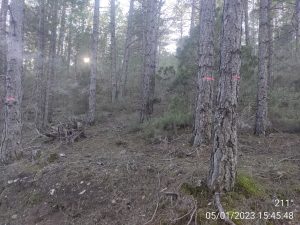
The forest “Umbría de Vadillos and Others” is located in the Serranía Alta de Cuenca, in the north of the province of Cuenca. It comprises (together with the forests called “Sierra de Priego, Loberas y Otros” and “Valdeavellano y Otros,” also owned by the Mancomunidad) almost the entire Municipal Term of Cañizares, except for MUP No. 183 and No. 184 “La Pinosilla” and “Terminillo de San Bartolomé” respectively and various private enclaves owned by the residents of Cañizares. The forest is located on sheet No. 539 (Beteta) at a scale of 1:50,000 on the national topographic map of Spain.
Instrument of Sustainable Forest Management
Technical Management Plan (valid for 12 years, 2022-2034) approved by Resolution of the Directorate General of Natural Environment and Biodiversity of the Junta de Comunidades de Castilla-La Mancha. Resolution date: March 25, 2022. A theoretical annual possibility of 848.12 m3 is established, to which a 30% reduction is applied, leaving a reserve mass for future regeneration problems. In this way, the real annual possibility is 593.68 m3.
A special D quarter (387.55 ha, representing 22.75% of the total area of the UGF) has been created in the eastern zone of the forest, where the steepest slopes (over 45%) and rockiness are located. The objective is to give this quarter a protective character, limiting actions in this quarter to improvement and sanitation cuts. Extra measures are established for the conservation of scarce, limited, vulnerable, or biodiversity-important natural habitats, as well as faunal resources.
Operational Specific Objectives
- Wood and firewood harvests should be aimed at proper natural regeneration of the stand, following the objectives set forth in the planning.
- Promote the proper development of the Pinus nigra and Pinus pinaster stands, avoiding the decline of trees due to lack of action.
- Erosion risk control.
- Habitat maintenance.
- Runoff regulation.
- Improve preventive measures for forest fire control.
- Stand health improvement.
- Enhance resistance to abiotic damage.
Policies and Management Objectives Defined in the Forest Management Instrument
- The main objective of the management plan is the physical and biological protection of the forest.
- Establish technical guidelines to ensure the persistence and stability of the stands.
- Achieve sustained yield or constant income condition. This objective is by definition established in the long term and should encompass the set of benefits provided by wooded areas, both economic and ecological.
Special Plan
- Harvesting and Use Regulation Plan.
1.1 Harvesting plan.
1.2 Grazing use plan.
1.3 Hunting use plan.
1.4 Mushroom picking plan.
1.5 Regulation of social or recreational use.
2. Valuation and income from harvests.
3. Improvements, investments, and actions plan.
3.1 Canton marking and conservation of dasocratic network roads.
3.2 Maintenance of forest roads.
3.3 Silvicultural treatments.
3.4 Operations of the Harvesting Plan.
4. Economic balance for the period of the Special Plan.
Specific Conservation Guidelines
Physical and biological protection, as general objectives:
– Erosion risk control
– Habitat maintenance
– Runoff regulation
– Improve preventive measures for forest fire control
– Stand health improvement
– Enhance resistance to abiotic damage
Physical and biological protection, as specific objectives:
– Avoidance of the removal of forest edges, banks, or shrub areas due to their importance for fauna.
– Maintenance of clearings and meadows.
– Differential treatments at the edge of the stand.
– Maintenance of enclaves with vegetation different from the main one.
– Conservation and protection of gallery forests and riparian vegetation.
– Maintenance of intact main vegetation enclaves in Quarter C and of monumental specimens throughout the forest.
– Maintenance of standing dead trees (recommendation to leave 2 to 4 dead trees per hectare
– Maintenance of protective covers for seedling trees.
Removal of cutting residues within established deadlines.
– In those places with an active erosion process or factors that may lead to these processes (slopes greater than 45%, low vegetative cover, easily erodible lithologies, etc.), the most appropriate cutting techniques will be planned to prevent or intensify these processes.
– Logging may be limited on slopes directly facing rivers, streams, or wetlands when it could disrupt the hydrological regime of the basin.
FMU 02 - VALDEAVELLANO AND OTHERS
Area: 1,846.70 ha
Group admission request: 3/9/2022
Documentation review: 25/11/2022
Field visit: 5/1/2023
Group adhesion contract: 15/9/2022
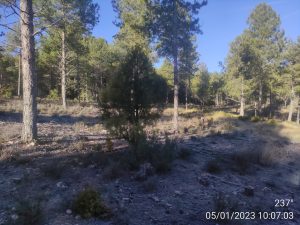
The forest “Valdeavellano and Others” is located in the Serranía Alta de Cuenca, in the north of the province of Cuenca. It comprises (together with the forests called “Sierra de Priego, Loberas y Otros” and “Umbría de Vadillos y Otros,” also owned by the Mancomunidad) almost the entire Municipal Term of Cañizares, except for MUP No. 183 and No. 184 “La Pinosilla” and “Terminillo de San Bartolomé” respectively and various private enclaves owned by the residents of Cañizares. The forest is located on sheet No. 539 (Beteta) at a scale of 1:50,000 on the national topographic map of Spain. The forest is nestled in the Serranía de Cuenca, on the foothills of the Montes Universales, within the Sistema Ibérico. It generally presents rugged topography with areas of steep slopes such as at the mouths of the streams of La Nava and Valdeavellano, and at the mouth of the Guadiela River, to the northwest of the forest, but also with the presence of flat areas and exposures to both sunlight and shade.
Instrument of Sustainable Forest Management
Technical Management Plan (valid for 12 years, 20217-2029) approved by Resolution of the Directorate General of Natural Environment and Biodiversity of the Junta de Comunidades de Castilla-La Mancha. Resolution date: January 18, 2017. A theoretical annual possibility of 3014.6 m3 is established, to which a 30% reduction is applied, leaving a reserve mass for future regeneration problems. In this way, the real annual possibility is 2110.22 m3.
A special C quarter (302.47 ha, representing 16.38% of the total area of the UGF) has been created in the western zone of the forest, including in it all areas with high slopes (over 45%) and rockiness, with the aim of giving this quarter a protective character, limiting actions to improvement and sanitation cuts, excluding regeneration cuts. The main objective of the forest is set as protective, and additional measures are established for the conservation of scarce, limited, vulnerable, or biodiversity-important natural habitats, as well as faunal resources.
Operational Specific Objectives
- Wood and firewood harvests should be aimed at proper natural regeneration of the stand, following the objectives set forth in the planning.
- Promote the proper development of the Pinus nigra and Pinus pinaster stands, avoiding the decline of trees due to lack of action.
- Erosion risk control.
- Habitat maintenance.
- Runoff regulation.
- Improve preventive measures for forest fire control.
- Stand health improvement.
- Enhance resistance to abiotic damage.
Policies and Management Objectives Defined in the Forest Management Instrument
- The main objective of the management plan is the physical and biological protection of the forest.
- Establish technical guidelines to ensure the persistence and stability of the stands.
- Achieve sustained yield or constant income condition. This objective is by definition established in the long term and should encompass the set of benefits provided by wooded areas, both economic and ecological.
Special Plan
- HARVESTING AND USE REGULATION PLAN.
1.1 Harvesting plan.
1.2 Grazing use plan.
1.3 Hunting use plan.
1.4 Mushroom picking plan.
1.5 Regulation of social or recreational use.
2. Valuation and income from harvests.
3. Improvements, investments, and actions plan.
3.1 Canton marking and conservation of dasocratic network roads.
3.2 Maintenance of forest roads.
3.3 Silvicultural treatments.
3.4 Operations of the Harvesting Plan.
4. Economic balance for the period of the Special Plan.
Specific Conservation Guidelines
Physical and biological protection, as general objectives:
– Erosion risk control
– Habitat maintenance
– Runoff regulation
– Improve preventive measures for forest fire control
– Stand health improvement
– Enhance resistance to abiotic damage
Physical and biological protection, as specific objectives:
– Avoidance of the removal of forest edges, banks, or shrub areas due to their importance for fauna.
– Maintenance of clearings and meadows.
– Differential treatments at the edge of the stand.
– Maintenance of enclaves with vegetation different from the main one.
– Conservation and protection of gallery forests and riparian vegetation.
– Maintenance of intact main vegetation enclaves in Quarter C and of monumental specimens throughout the forest.
– Maintenance of standing dead trees (recommendation to leave 2 to 4 dead trees per hectare) and on the ground.
– Maintenance of protective covers for seedling trees.
– Removal of cutting residues within established deadlines.
– In those places with an active erosion process or factors that may lead to these processes (slopes greater than 45%, low vegetative cover, easily erodible lithologies, etc.), the most appropriate cutting techniques will be planned to prevent or intensify these processes.
– Logging may be limited on slopes directly facing rivers, streams, or wetlands when it could disrupt the hydrological regime of the basin.
FMU 03 - SIERRA DE PRIEGO, DEHESA, LOBERAS AND OTHERS
Area: 2,335.60 ha
Group admission request: 3/9/2022
Documentation review: 25/11/2022
Field visit: 5/1/2023
Group adhesion contract: 15/9/2022
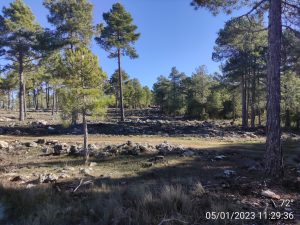
The forest belonging to the Mancomunidad de Montes Particulares de Cañizares, in the province of Cuenca, is located near the urban nucleus of Cañizares. It is situated on sheets No. 538 (Valdeolivas) and No. 563 (Priego) at a scale of 1:50,000 on the national topographic map of Spain. The forest is nestled in the Serranía de Cuenca, on the foothills of the Montes Universales, within the Sistema Ibérico. It generally presents rugged topography with areas of steep slopes such as Hocecilla, Pozo de la Jara, the slopes of the Tragavivos ravine, and the Sierra de Priego, but also with the presence of flat areas and exposures to both sunlight and shade.
Instrument of Sustainable Forest Management
Technical Management Plan (valid for 12 years, 2015-2026) approved by Resolution of the Directorate General of Natural Environment and Biodiversity of the Junta de Comunidades de Castilla-La Mancha. Resolution date: November 26, 2015.
An annual possibility of 1499.5 m3 is established, with a growth of 1454.7 m3. This is because it was found during the review that in the previous special plan, hardly any wood was cut, so the forest is very capitalized in terms of timber resources. In no case will this cutting intensity compromise the persistence of the forest.
A reserve D quarter (497.26 ha, representing 24.17% of the total area of the UGF) has been created, including in it all areas with high slopes (over 45%) to give it a protective character, limiting actions in said quarter to police cuts focused on the elimination of dominated, deformed, diseased, pest-affected, punky, or abiotically damaged trees.
A fund for improvements has been created, reserving 15% of the projected income from the forest to carry out those works considered beneficial such as silvicultural treatments for fire or pest and disease prevention, infrastructure conservation, and improvement of roads and water passages.
Operational Specific Objectives
- Specific protection will be given to areas containing nesting sites or any determinant element for the conservation of species included in the Regional Catalog of Threatened Species (CREA, Law 9/1999, of May 26, on Nature Conservation in Castilla-La Mancha).
- The oak stand will be subject to conservation due to the ecological value it brings to the forest, as well as its more varied reproduction strategies compared to the pine forest, which provide defense against severe disturbances affecting the forest stand, such as forest fires.
- In the pine forest, efforts should be made to maintain the presence of species populating the forest, both to conserve this diversity and to better prepare the stand to respond to external actions, due to the ecological and resistance differences to events that these species have.
- Job creation, benefiting local workers.
- Efforts will be made to minimize interventions in those areas that, due to their intra-zonal or azonal character, may have the presence of rare or scarce plant species in the area, due to their value in increasing biodiversity, especially plant species included in the aforementioned CREA.
Policies and Management Objectives Defined in the Forest Management Instrument
- Management plans will include conservation actions in accordance with the objectives, zoning, and regulations established in higher-level planning documents.
- Rationally promote social use of the forest.
- Non-intervention will be considered as one of the management options, with the explicit objective of conserving species, habitats, or key ecological processes and a long-term commitment to permanence. In forests included in protected areas, non-intervention zones should, except for justified exceptions, be established as a planned management decision to assess the natural evolution of forest systems.
- Precautionary principle will be preferred when proven techniques are not available, especially regarding the possible interference of new uses and silvicultural treatments with the presence of key species, habitats, or ecological processes, or with their phenology.
In protected areas, planning must consider the objective of recovering native taxa, tending towards the progressive elimination of populations of exotic taxa, except when their disappearance could compromise conservation objectives. Productive objectives must be achieved with taxa native to local natural systems.
Special Plan
- Review of the previous special plan.
- Validity.
- Uses
- Timber use.
- Cutting plan.
- Other uses.
- Economic quantification.
- Improvements.
- Financial balance.
- Conservation guidelines.
Specific Conservation Guidelines
Basic conservation guidelines:
- Management plans will include conservation actions in accordance with the objectives, zoning, and regulations established in higher-level planning documents.
- Non-intervention will be considered as one of the management options, with the explicit objective of conserving species, habitats, or key ecological processes and a long-term commitment to permanence. In forests included in protected areas, non-intervention zones should, except for justified exceptions, be established as a planned management decision to assess the natural evolution of forest systems.
- Precautionary principle will be preferred when proven techniques are not available, especially regarding the possible interference of new uses and silvicultural treatments with the presence of key species, habitats, or ecological processes, or with their phenology.
- In protected areas, planning must consider the objective of recovering native taxa, tending towards the progressive elimination of populations of exotic taxa, except when their disappearance could compromise conservation objectives. Productive objectives must be achieved with taxa native to local natural systems.
Specific conservation guidelines:
- Specific protection will be given to areas containing nesting sites or any determinant element for the conservation of species included in the Regional Catalog of Threatened Species (CREA2, Law 9/1999, of May 26, on Nature Conservation in Castilla-La Mancha).
- Efforts will be made to minimize interventions in those areas that, due to their intra-zonal or azonal character, may have the presence of rare or scarce plant species in the area, due to their value in increasing biodiversity, especially plant
species included in the aforementioned CREA.
- In the pine forest, efforts should be made to maintain the presence of species populating the forest, both to conserve this diversity and to better prepare the stand to respond to external actions, due to the ecological and resistance differences to events that these species have.
- The oak stand will be subject to conservation due to the ecological value it brings to the forest, as well as its more varied reproduction strategies compared to the pine forest, which provide defense against severe disturbances affecting the forest stand, such as forest fires.